Learning Machine Learning: an interactive explorable
I adapted TensorFlow's Playground into a guided tool for learning what each ML hyperparameter actually does.
For EDUC432, I adapted TensorFlow's Playground into a tool that helps you learn what different hyperparameters actually do when training a neural net. This is the explorable I wish I had for my CS229 project.
The idea
Across the ML courses I took I kept running into the same gap: I understood the math for why training works, but I didn't have an intuition for how to manage each hyperparameter when training a model. This project turns that into something the user can immediately see. You adjust a knob, watch the model change, and build intuition directly.
What I built
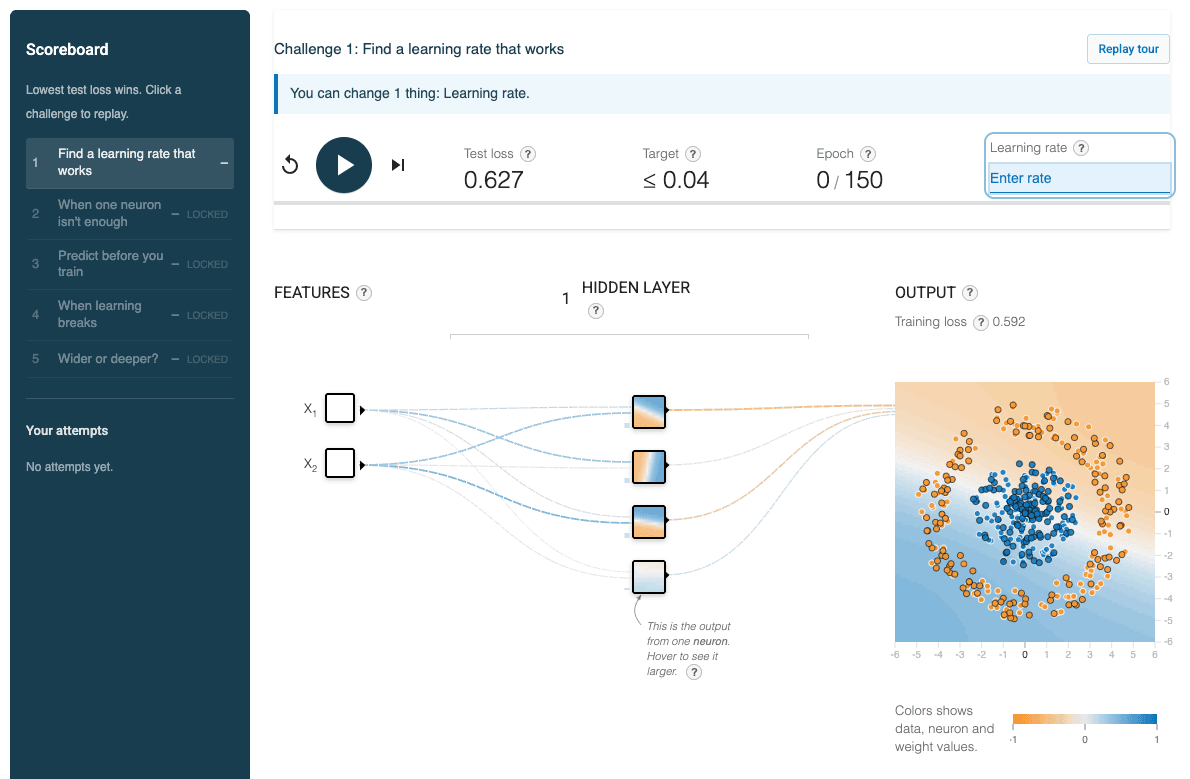
I took TensorFlow's Playground and reshaped it into a guided learning experience, so that instead of just fiddling with a neural net, you're led through what learning rate, regularization, layers, and the rest do to how a model learns.
What I learned
- Designing for learning: I designed a curriculum that built intuition step by step instead of dumping all the controls at once.
- Cognitive load theory: design a learning experience by increasing germane cognitive loadWorking memory is limited, and three things compete for it. Intrinsic load is the difficulty of the material itself (a learning rate really does interact with everything else). Extraneous (or extrinsic) load is everything the design wastes attention on: 20 knobs at once, unexplained jargon, hunting for the play button. Germane load is the effort that actually builds the mental model. Extraneous load is the one you cut, because every bit you remove frees working memory for the germane kind. So: one unlocked knob per challenge, and a prediction before each run..